
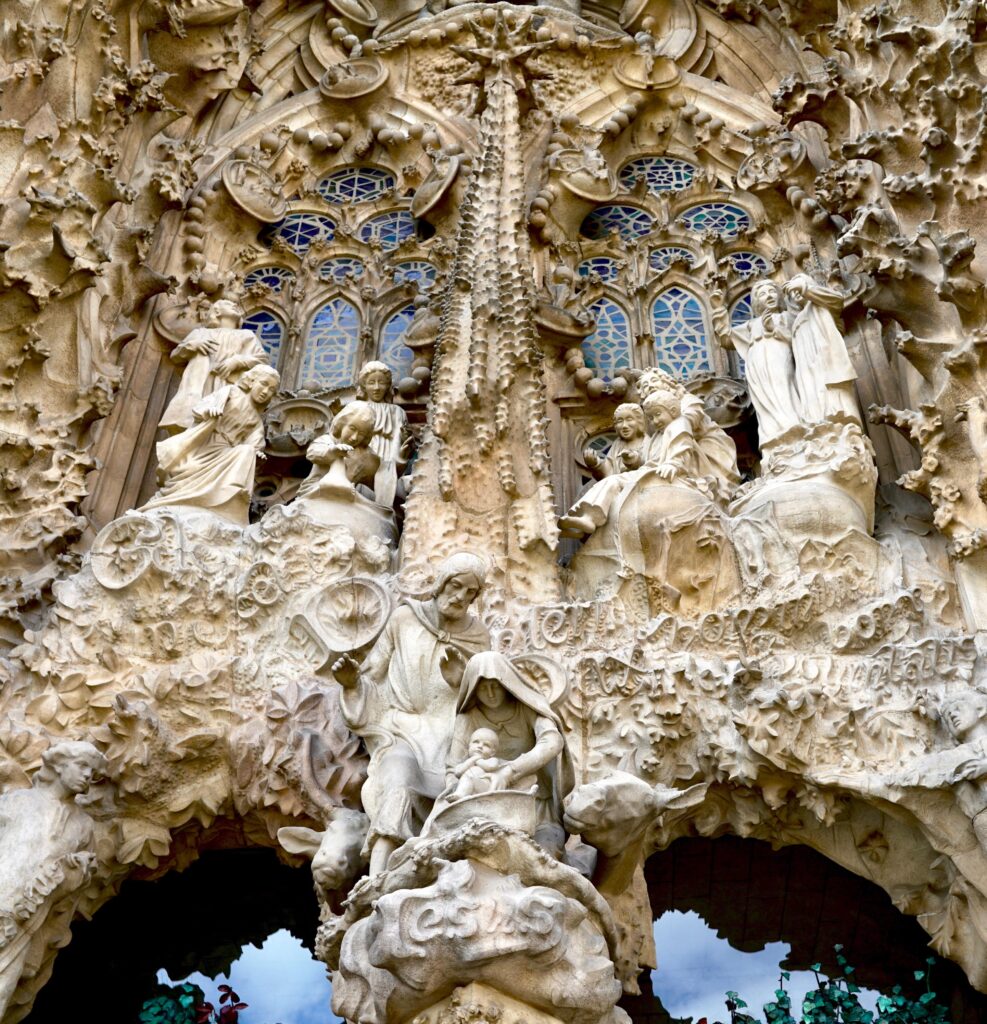
On 20 February, 2026, engineers carefully installed an immense 100 ton cross1 atop the central tower of Jesus Christ, marking the culmination of Antoni Gaudí’s 144-year construction project – and his magnum opus – Sagrada Família. The central tower of the Spanish basilica also makes it the world’s tallest church, standing at 172.5m. But, while the scale of Sagrada Família is extraordinary, it’s the intricate designs and unique combination of Gothic and curvilinear Art Nouveau forms that makes Gaudí’s architecture so impressive.

The basilica’s exterior Nativity façade to the east, for example, features portals packed with intense, highly detailed biblical storytelling, displayed in stark visual contrast to the wax-like stone entwined with realistic local flora, fauna, and twisting marine life. In fact, all around Barcelona we see evidence of Gaudí’s genius: the trencadís technique using recycled shards of broken ceramics, tiles and glass at Park Güell; the hand-crafted wrought iron nature designs, such as the dragon gate at the Finca Güell; and, the hexagonal floor tiles featuring relief drawings of starfish, snails, and octopus dotted all around the city.



At some point, though, we stopped caring about architectural design and lost pride in our work. The brilliance of Gaudí gradually faded into the distant past, followed first by increasingly austere modernism and, later, the ubiquitous cookie-cutter architecture that systematically stripped out the human-centric design of our building to cut-costs for developers. In other words, we just stopped caring.
At some point, we just stopped caring.
The modern term for this movement is DefinitionS1enshittification /ɛnˌʃɪtəfɪˈkeɪʃən/ - n. The gradual degradation of something as quality, care or user value is sacrificed for extraction, convenience or efficiency. – the gradual loss of quality we all experience in our life when people stop making intentional, thoughtful and diligent effort to do good work for themselves and others. And this decay is worryingly visible everywhere around us, way beyond the physical enshittification of our architecture.
For example, the cognitive enshittification that comes from valuing instant pleasure and convenience over patience and critical thought. We’re slowly outsourcing our brain by getting AI to do our thinking, consuming text summaries instant of reading books, and relying on short-form videos for dopamine. Worse still, is the epistemic enshittification of valuing engagement and confirmation bias over truth and objective reality. We no longer care to think for ourselves, believe in ourselves or be curious about the world we live in.
There’s also the sort of enshittification that comes from valuing inhumane metrics over human experience – a sort of systematic enshittification. This is what Cory Doctorow2 talks about when describing the predictable, multi-step decay of dominant digital platforms like Facebook, Netflix or Amazon. First, the platform is good to its users and builds a massive user base. Once users are locked in, the platform abuses them to transfer value and profit to its business customers. Then, once business clients are locked in, the platforms turns on both groups to maximise returns for its shareholders until the platform because a useless, broken husk (e.g. Google search results crowded with ads or Amazon prioritising sponsored junk). It’s also the type of enshittification that replaces proper customer service with unhelpful chatbots and entrenches institutional decay.
Be good to users
Exploit users for business customers
Exploit both for shareholders
This has been most noticeable to me in hospital and universities. In healthcare, administrators place strict quotas on the length of patient visits, so instead of trying to deliver proper treatment doctors are forced to treat human care like an assembly line to hit artificial efficiency targets. Meanwhile, in higher education, universities continuously raise tuition to fund an ever-expanding layer of administrative bureaucracy, while replacing tenured professors with underpaid adjunct instructors (or, nobody at all) and treating students as revenue-generating data points rather than humans passionate about learning. In both cases, the primary mission – healing people and educating people – is Goodhart's LawS2When a measure becomes a target, it ceases to be a good measure. Measure patient throughput long enough and eventually you optimise for throughput rather than care. to satisfy compliance checklists and balance sheets.
The reality is that enshittification has crept into the tiny recesses of every aspect of our life and it’s making our lives miserable. From the relational enshittification brought about by dating apps that incentivises transactional efficiency over genuine intimacy to the cultural enshittification that leads Hollywood to create endless sequels because it’s far safer to create something with mass-appeal than take artistic risk because god forbid a movie pisses a few people off or earns a few million dollars less at the box office. We’ve optimised for efficiency and, in doing so, we sacrificed the value of friction.
Friction is what makes a bridge beautiful, a relationship exciting, a life meaningful, and ensures a product lasts a lifetime. By removing friction from our lives – not giving ourselves the time, effort, patience, and love to do things with intentionality and proper care – we lose substantially more than we’d ever hope to gain. And I genuinely believe this realisation could change almost everyone’s life for the better.
A Necessary Distinction
Not all friction is good. Pointless bureaucracy, inaccessible design, needless waiting and repetitive labour do not magically make us better people.
The friction worth protecting is the kind involved in attention, craft, mastery, discovery, commitment and care. The goal isn’t to make life harder, but we do need to stop treating every form of effort as a defect.
So, what happened? Why have we collectively decided that being efficient is more important than the friction involved with being thoughtful, attentive, and meticulous in our actions? What is the great appeal in being fast and shitty, compared to being a little slower but having immense pride in what we do? The answer lies in our modern obsession with saving money and time, at all costs.
Firstly, enshittification is cheap. If it costs 100x less to build something that satisfies the bare minimum legal and functional requirements, capitalistic efficiency dictates that the extra budget for beauty (and other finer details) is a waste. Businesses have realised that they can get away with using lower-quality materials that boost their profit margins, with very little backlash. This is made worse by platforms like Temu that have conditioned consumers to expect unsustainably cheap prices, making the actual cost of high-quality, ethically made goods look outrageously expensive by comparison.
Secondly, enshittification is fast. Modern society treats time spent waiting, thinking, or practicing as a fault to be corrected. If a quick Google search delivers a concise summary of Macbeth and ChatGPT can write our essay in 2 minutes, the slow alternative of reading and writing everything ourselves begins to feel like a structural failure. Unfortunately, things are only going to get worse. The more we outsource our brain to save time, the more our attention span shrinks creating a hugely detrimental feedback loop: we lack the patience for slow things, so we demand faster things, which further degrades our capacity to focus and do things properly.
We’ve reached a point where we’re psychologically desensitised to enshittification. It’s the NoteS3The boiling-frog story is probably bad zoology. Healthy frogs generally attempt to escape dangerously warming conditions. Unfortunately, the metaphor may describe humans better than frogs., except instead of a frog sitting in a gradually boiling pot of water it’s all of us sitting in a steaming pile of excrement and getting more comfortable as time goes by. When a platform introduces two more ads, a clothing brand switches to a 10% cheaper fabric blend, or a software engineer writes one more line of code with AI, quality gradually declines. And because it happens incrementally, our baseline of what is “acceptable” continuously drops too. For example, when a book feels too slow, it’s because our cognitive tolerance for boredom has been enshittified by the infinite scroll.
We’re psychologically desensitised to shit.
Now, I get it, fighting enshittification is hard work. It takes effort to intentionally seek out slow media, think for ourselves, and to fight against the few massive corporations that don’t have to compete on quality anymore. But, fight, we must. When you give in to enshittification and live a frictionless life, you’re allowing algorithms and corporations to slowly downgrade what it means to be human, erasing your individuality, your competence, and your joy. You lose way more than the convenience you’re hoping to gain:
- You lose your agency. When you let algorithms choose your music, AI write your emails, and delivery apps choose your food, you stop making choices. You become a statistical data point. Friction is the spark of free will. When you do something the hard way, you step off the predictable track laid out for you by businesses and reclaim ownership over your own day
- You lose your edge. Muscle group atrophy happens when you stop lifting weights. Likewise, cognitive atrophy happens when you stop thinking. If you outsource every difficult mental task to an app, your ability to solve complex problems, sit with deep thoughts, and focus on hard tasks shrinks. Caring about friction is mental survival. It keeps your mind sharp and capable of thinking for itself.
- You lose your colour. When everything is optimised for mass appeal, low cost, and instant speed, the world loses its texture. Architecture becomes grey boxes, music becomes 15-second loops, and writing becomes sterile AI prose. Friction is where art and beauty lives. As I write this, I’m looking at Porto’s Dom Luís I Bridge from my window – it’s the sort of view that leaves a permanent mark on your soul, in the same way reading a hard book does. A frictionless scroll on TikTok, in comparison, leaves you feeling empty inside.
- You lose your presence. When you spend your day mindlessly surfing the internet and have no real friction in your life, your days can become less memorable because so little demands sustained attention or feels genuinely distinct3. Friction anchors you to reality. The struggle to learn an instrument, the physical effort of crafting something, or the patience required to read a book stretches time out and makes life feel vivid and remembered.
The bottom line is that we should start caring because the alternative is a numb, forgettable existence.
My own struggles with depression and anxiety were rooted in the pursuit of effortless efficiency. I didn’t give myself time to slow down, touch grass, and smell the roses. In trying to optimise every second of my existence, I accidentally engineered the job right out of it. I treated my life like a machine to be streamlined rather than an experience to be felt, convinced that if I could just do enough or move fast enough, I’d finally earn the right to be happy.
But I’m slowly coming to terms with the fact that peace and happiness doesn’t come from being more efficient. Instead, it comes from doing more of the things that make us human and actually giving a shit. Whether it’s reading a book on the beach, spending more time with my family, taking real pride in my work, or giving myself the simple grace of just being. After all, the best parts of being alive were never meant to be efficient.
- This is how the cross on the tower of Jesus was built. ↩︎
- Social Quitting. Cory Doctorow originally coined enshittification when talking specifically about digital platforms. I’m abusing his word slightly. I think it deserves a bigger job. ↩︎
- Attention versus significance-driven memory formation. Memory formation is strongly shaped by attention and by the significance of an experience, including novelty and emotion. Distinctive experiences therefore have more going for them than an interchangeable stream of low-attention stimulation. ↩︎