
- An economic model is a simplified map of the real world that helps economists understand cause and effect.
- Because the real world is messy and complicated, a model strips away unnecessary clutter to focus on how just a few key factors (variables) interact – like how price affects sales, or how unemployment affects spending.
- It serves two main purposes:
- To explain: it shows how the economy works right now (e.g. “when supply drops, prices usually rise”)
- To predict: it acts like a financial weather forecast to test “what-if” scenarios (e.g. “if the government raises fuel taxes by 10%, how much will driving decrease next year?)
Example: Income Threshold Model and China
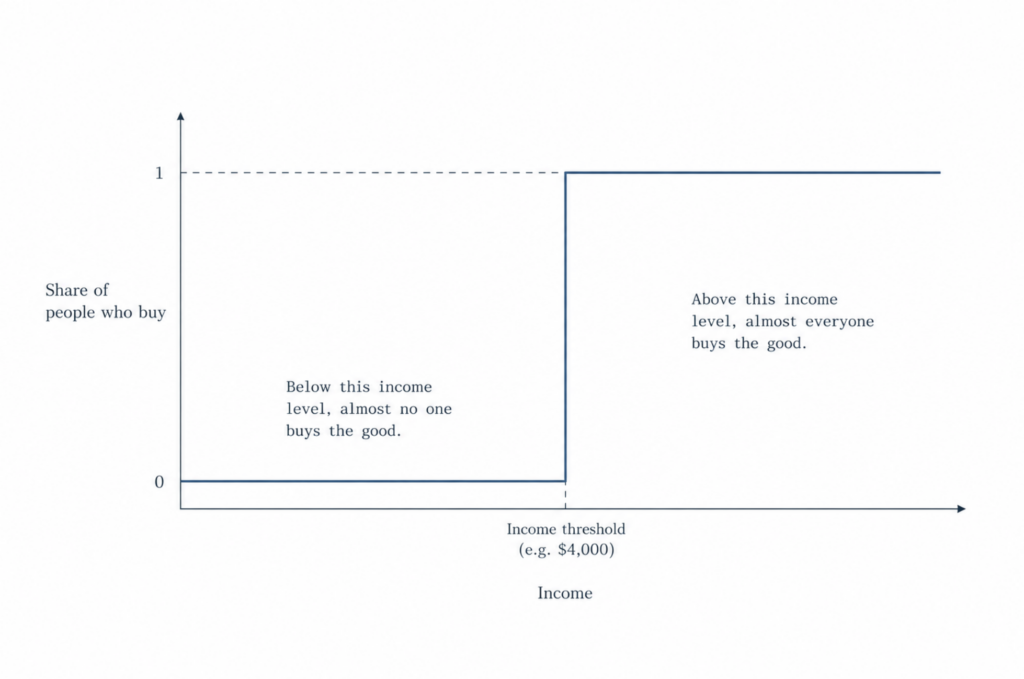
- The Income Threshold Model explains how sales of expensive, long-lasting goods (like cars or refrigerators) explode in developing countries once people reach a specific level of wealth
- Think of income like an “on/off switch” for big purchases:
- Below the threshold almost nobody buys the product because they simply can’t afford it.
- Above the threshold almost everybody buys it because it has suddenly become accessible.
- Because millions of citizens in a growing economy cross that magic income line around the same time, sales don’t just creep up slowly. Instead, they surge overnight.
- For example, china’s car boom:
- In countries like Malaysia and China, the “magic number” to buy a car is around $4,000 per year. As China’s economy grew, millions of families crossed this line for the first time.
- Because so many people crossed the line at once, 80% of all new car buyers in China were first-time owners.
- Between 2000 and 2020, car sales in China grew nearly 18 times over, turning China into the largest auto producer in the world – manufacturing roughly 1 out of every 3 cars on the planet.
Simplifications by Assumptions
- Economists make many assumptions to simplify their models
- In our income threshold model, for example, we assume that factors other than income, such as the colour of cars, are irrelevant to consumers’ buying decision
- Therefore, we ignore cars’ colours when describing the relationship between average income and the number of cars consumers want.
Testing Theories
- Economic theory is the development and use of a model to test hypotheses, which are predictions about cause and effect.
- We are interested in models that make clear, testable predictions, such as “If the price rises, the quantity demanded falls.”
- Economists test theories by checking whether predictions are correct
- If a prediction does not come true, they may reject the theory
- Economists use a model until evidence refutes it or someone creates a better model.
Maximising Within Constraints
- In economic models, everyone is trying to get the best possible result, but they are always boxed in by rules:
- Consumers: Want to maximise their happiness or well-being, but are restricted by a budget constraint (they can only buy what their money allows).
- Firms: Want to maximise their profits, but are restricted by technological and cost constraints (what they are actually able to build and afford).
- Governments: Want to maximise public welfare, but are restricted by limited resources and the unpredictable behaviour of people and businesses.
- Because everyone is managing limits, society has to figure out three main things: what gets produced, how it is made, and who gets to buy it.
Positive vs Normative
- In economics, statements are divided into two distinct categories based on whether they deal with hard facts or personal opinions.
Positive Statements (Facts and “What Is”)
- Positive statements are objective descriptions or predictions about how the world actually works.
- They focus on facts, data, and cause-and-effect relationships.
- They can be proven true or false by looking at evidence and data.
- E.g. “Raising the minimum wage increases unemployment among teenagers.” is a positive statement. You can look at historical job data to check whether this statement is factually right or wrong. It doesn’t matter if you like the minimum wage or hate it, the statement is just claiming a measurable fact
Normative Statements (Opinions and “What Should Be”)
- Normative statements involve value judgments, ethics, and opinions about how the world ought to be.
- They focus on policy, ideals, fairness, and what choices should be made.
- They cannot be proven true or false with data because they are based on personal values and beliefs.
- E.g. “The government should raise the minimum wage to help reduce poverty.”