
- The network layer can be split into 2 interacting parts: the data plane and the control plane.
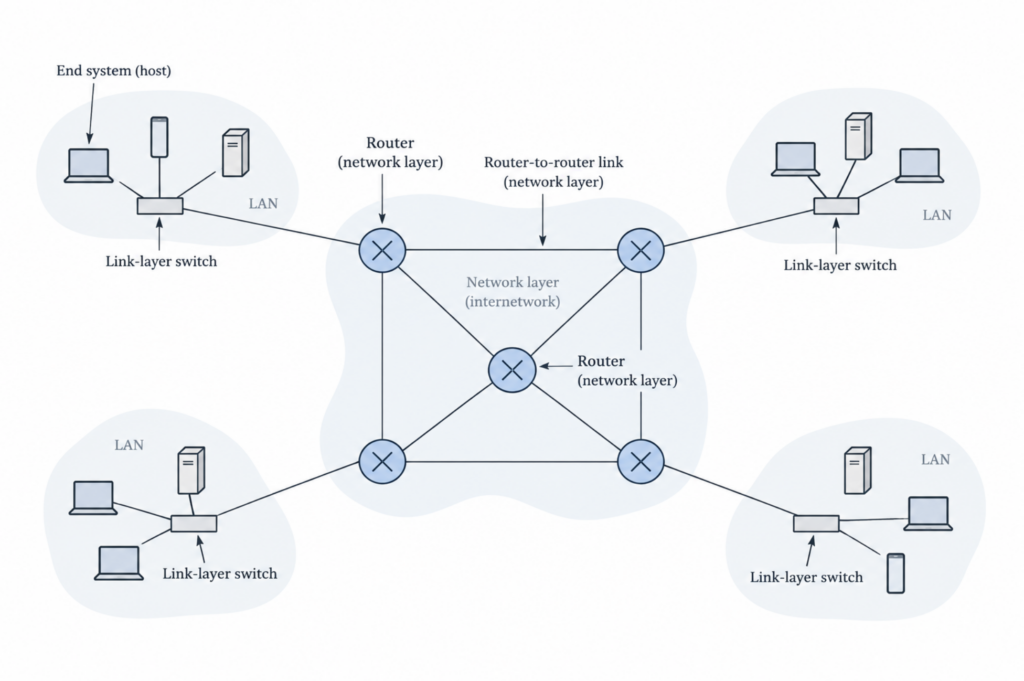
- This shows a simple network – the network layer in one host takes segments from the transport layer, encapsulates that segment in a datagram and sends that data to a nearby router. At the receiving host, the network layer receives the datagram for a nearby router, extracts the transport layer segments, and delivers the segments up to the transport layer.
- The primary data-plane role of each router is to forward datagrams from its input links to its output links
- The primary role of the network control plane is to coordinate these local, per-router forwarding actions so the datagrams are ultimately transferred successfully along the routers from one host to the other host.
Forwarding and Routing: Data and Control Planes
- The network layer sends data from a sending host to a receiving host using two mechanisms:
- Forwarding: when a packet arrives at a router’s input link the router must move the packet to the appropriate output link (such that the data is moving rom router to router on its path to the destination host).
- Routing: the network layer must determine the route or path each packet takes as the flow from a sender to a receiver. The paths taken are determined by routing algorithms.
Forwarding vs Routing
People often use these terms interchangeably. But, forwarding is about action local to the router taking placing across a very short timescale (nanoseconds), often implemented in hardware. Routing is the network-wide process that takes packets from source to destination, which can take much longer (seconds) and is often implemented in software.
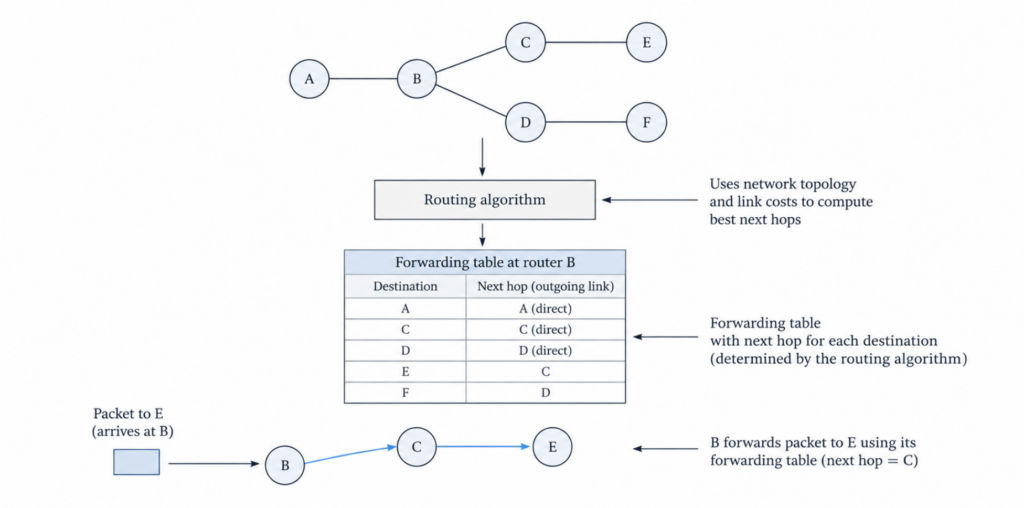
- A key part of every network router is its forwarding table
- Whenever a packet arrives at a router it:
- Checks the label: the router looks at specific header fields on the incoming packet (e.g. reading a code like
0110). - Consults the cheat sheet: it looks up that code in its forwarding table (a local directory that maps address codes to physical exit doors).
- Sends it out: the table says code
0110goes to Interface 2, so the router instantly pushes the packet through internal hardware to exit out of interface 2.
- Checks the label: the router looks at specific header fields on the incoming packet (e.g. reading a code like
- So it’s this lightning-fast lookup and hardware transfer that we call forwarding. It’s the primary job of the data plane – the hardware responsible for processing every single packet passing through the network without delay.
Control Plane: The Traditional Approach
- Routers constantly talk to each other using routing protocols.
- They exchange status messages (e.g. “Router C is overloaded” or “Link A is down”) so every router can run a routing algorithm and update its own forwarding table dynamically.
- Humans could technically update these forwarding tables themselves (and therefore no routing protocols would be required), but humans are slow and make mistakes
- E.g. if a physical fibre cable gets cut at 3 AM, human operators couldn’t manually update thousands of router tables fast enough to keep the internet running. Automated routing algorithms fix broken paths in milliseconds.
- This is why it’s important we have both forwarding tables and a routing function.
Control Plane: The SDN Approach
- The approach to routing with each router having a routing component that can talk with the routing components of other routers has, until recently, been the main way things work.
- But there are other ways to determine the contents of the data-plane forwarding tables.
- For example, we could have a physically separate, remote controller computing and distributing the forwarding tables to be used by each and every router within a network:
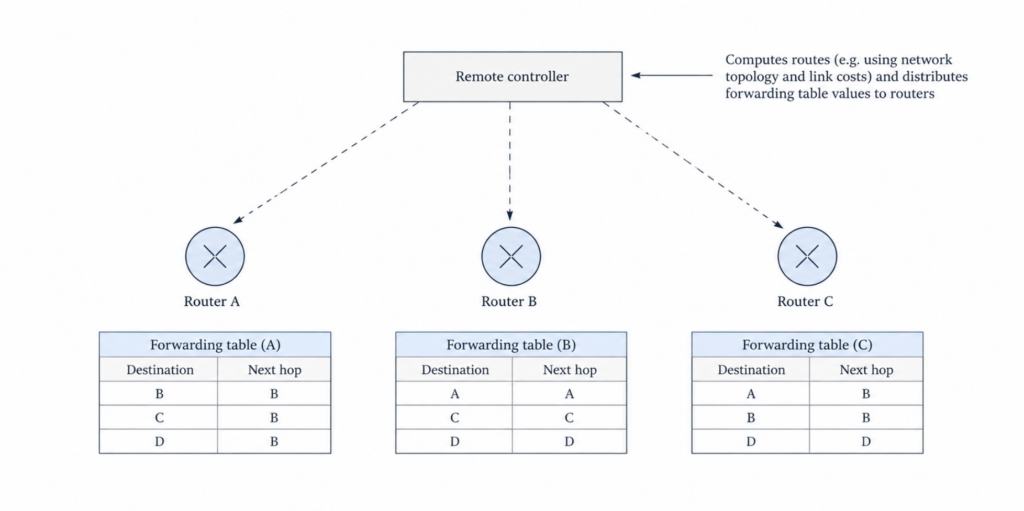
- Here the data-plane component is the same as above, but the control-plane routing is separate from the physical device i.e. the routers do forwarding only, while the remote controller computes and distributes the forwarding tables.
- So that’s the general idea of Software-Defined Networking (SDN), where a centralised software system running in a remote data centre calculates all the best paths and sends completed forwarding tables down to the routers.
- The central software controller constantly sends messages over the network to each physical router, updating their forwarding tables in real time whenever network conditions change.
- Much like Linux, SDN software is often open-source. This allows companies and researchers to write custom rules and software that controls network-layer functionality.
Network Service Model
- The network service layer could provide a few possible services:
- Guaranteed delivery: it guarantees that a packet sent by one host eventually arrives at the destination host.
- Guaranteed delivery with bounded delay: it not only guarantees data delivery, but delivery within a specific timeframe (e.g. within 100 msec).
- In-order packet delivery: it guarantees packets arrive at the destination in the order they were sent.
- Guaranteed minimal bandwidth: it can act like renting a private dedicated cable between two computers over the shared internet. So even though packets travel through shared routers across the internet, the network reserves dedicated capacity so it feels like a direct, private physical wire. As long as the sender stays under the agreed speed limit (e.g., 1 Mbps), the network guarantees 100% packet delivery.
- The Internet’s network layer provides a single service, known as best-effort service.
- With best-effort service, packets are neither guaranteed to be received in the order in which they were sent, nor is their eventual delivery even guaranteed.
- There is also no guarantee on the end-to-end delay nor is there a minimal bandwidth guarantee.
- This doesn’t sound great and proposals have been made to improve it.
- But, in spite of these proposals, the best-effort service is still seen as broadly adequate.