Overview
- All cellular organisms uses DNA (deoxyribonucleic acid) to store genetic information
- In all biological macromolecules there’s an intimate relationship between structure and function
- E.g. DNA’s structure makes it great at storing information
DNA’s construction
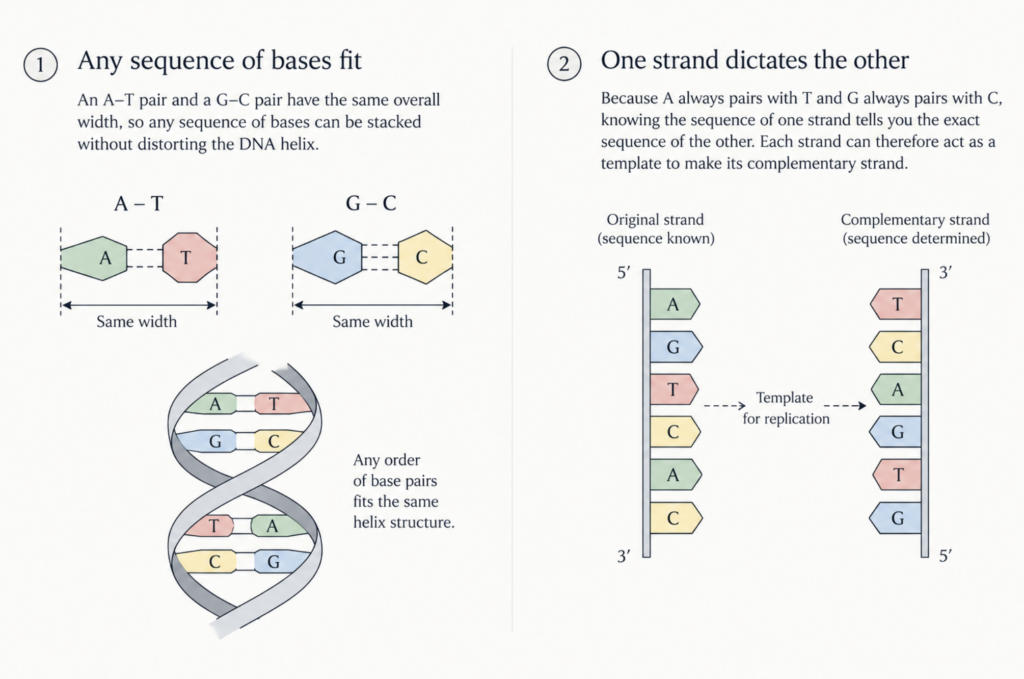
- DNA is a linear polymer, which means they are large molecules made up of many smaller molecules
Definition of a polymer
A polymer is a molecule made up of numerous small molecules called monomers that are joined together to form a larger molecule. The word “polymer” is made up of two parts: “poly” which means “many,” and “mer” which means “unit.” A linear polymer means just a long straight chain.
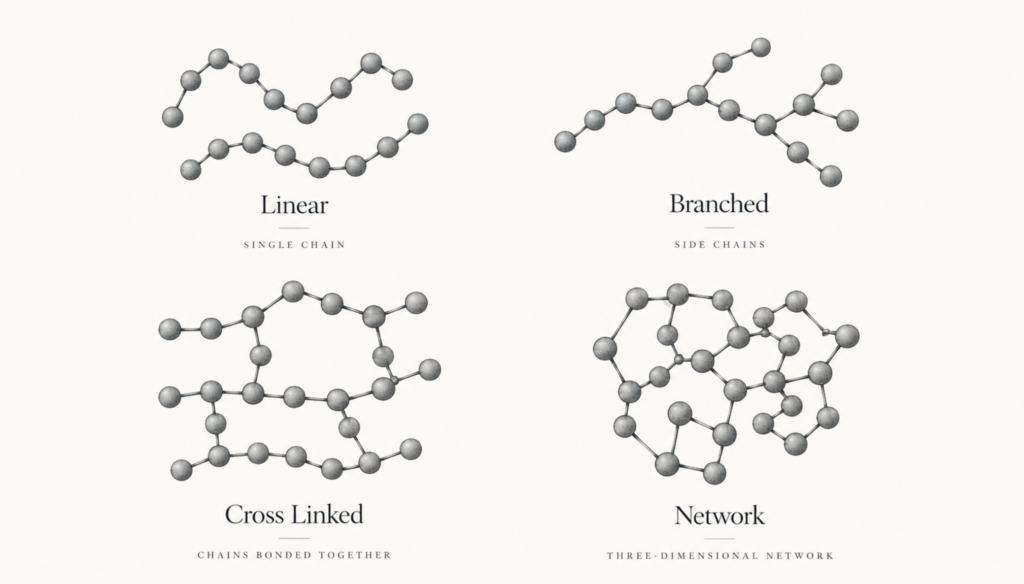
- The small molecules that make up DNA are called nucleotides.
- Each nucleotide contains a phosphate group, a sugar molecule (called deoxyribose), and a nitrogenous base.
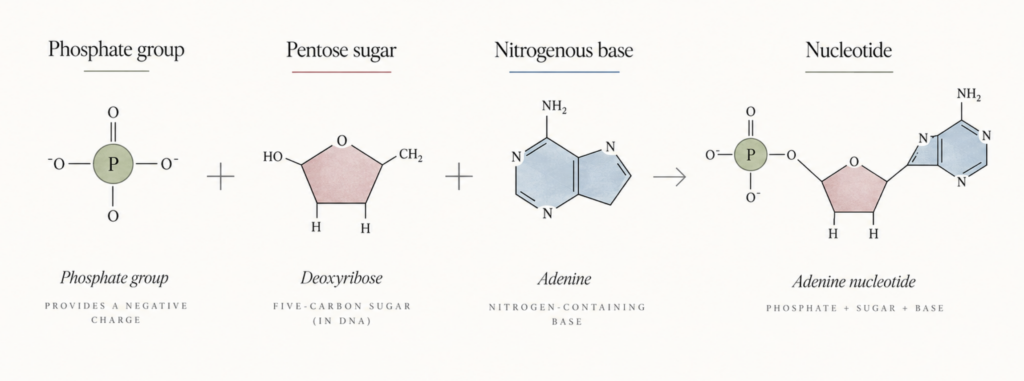
- Joined to each deoxyribose is one of four possible nitrogenous bases: adenine (A), cytosine (C), guanine (G), and thymine (T).
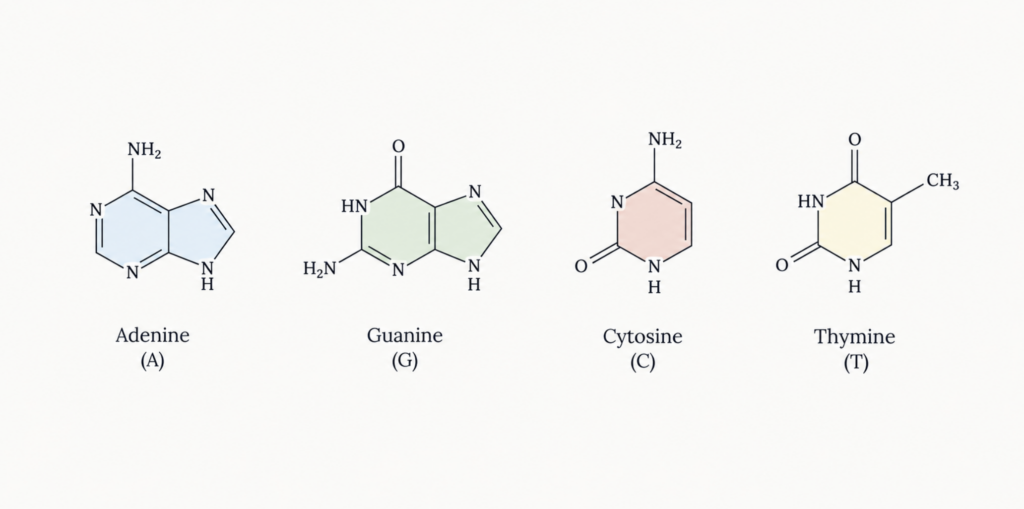
- These bases can be arranged in any order along a strand of DNA.
The Double Helix
- Most DNA molecules consist of two intertwined strands, forming a double helix arranged such that the sugar–phosphate backbone lies on the outside and the nitrogenous bases sit on the inside.
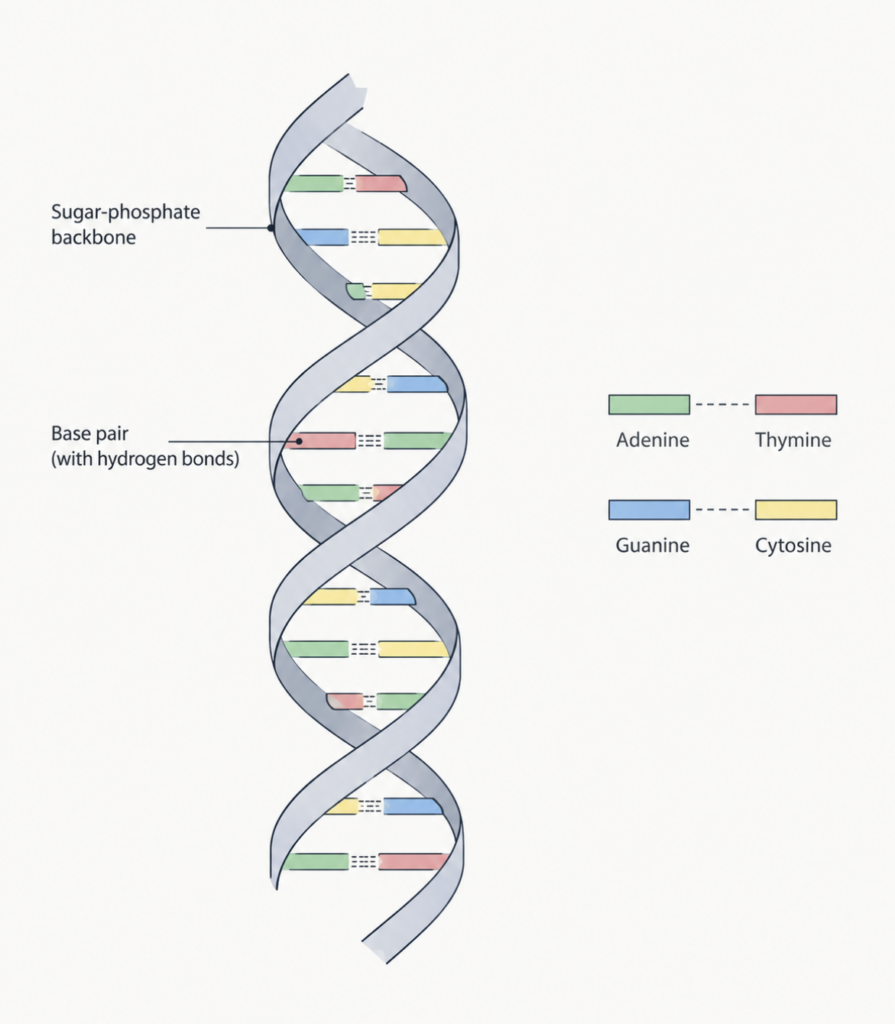
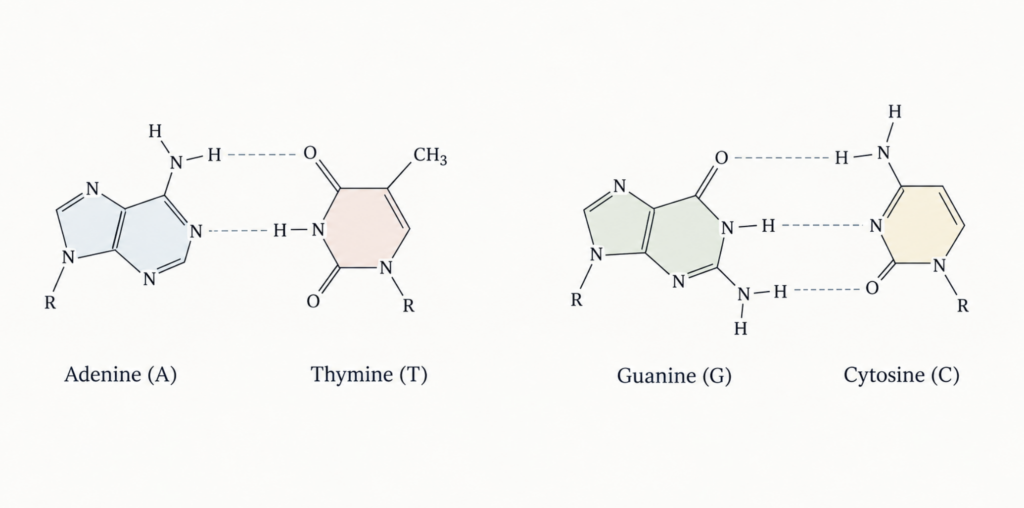
- The key to this structure is that the bases form specific base pairs held together by hydrogen bonds:
- Adenine pairs with thyme (A-T), and
- Guanine pairs with cytosine (G-C)
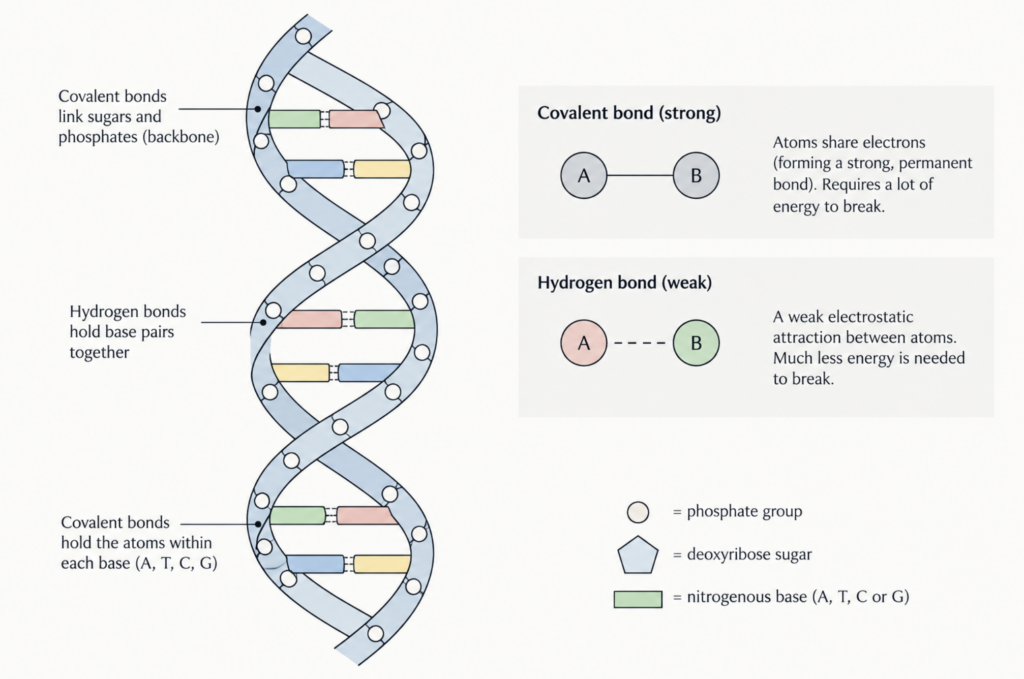
- Covalent bonds (strong, permanent chemical links) build the actual physical pieces of the DNA. They form when atoms are electrons, requiring a lot of energy to break.
- In DNA, covalent bonds do two main jobs:
- They build the backbone of each strand (linking the sugars and phosphates together).
- They hold the individual atoms of each genetic “letter” (A, T, C, G) together
- But hydrogen bonds are much weaker, holding together the individual base pairs.
- The reason for this is down to a fundamental requirement of DNA: it must be indestructible, but easy to open.
- Covalent bonds protect the code: you don’t want the actual sequence of letters to change or break apart. So the strong covalent bonds ensure that an individual strand of DNA remains a permanent, solid chain.
- Hydrogen bonds allow access: to copy or read DNA, the cell has to separate the two strands. If the two strands were held together by strong covalent bonds, unzipping them would require so much force that it would tear the individual strands apart and destroy the genetic code.
- By using covalent bonds along the length of each strand and hydrogen bonds across the middle between the two strands, DNA gets the best of both worlds: a permanent, unbreakable skeleton holding the message, and a soft, zip-able middle that allows the cell to read the message whenever it needs to.
Genetic Material
There are two structural properties of the DNA double helix that explain how it functions as genetic material:
- Any sequence of bases fit
- Even though A, T, C, and G are individual molecules with different shapes, an A-T pair and a G-C pair have virtually identical overall physical dimensions when bound together.
- Because every base pair takes up the exact same amount of spatial room inside the helix, they can be stacked in any arbitrary order without distorting or warping the DNA molecule’s overall shape.
- This structural flexibility allows DNA to use base sequences like an alphabet, storing infinite variation to code for RNA and proteins.
- One strand dictates the other
- Because of strict base-pairing rules (A always pairs with T, G always pairs with C), knowing the sequence of one strand automatically tells you the exact sequence of the opposing strand.
- If the two strands are separated down the middle, each single strand serves as a direct chemical template.
- Enzymes can read each isolated strand and assemble an exact replica of its missing partner strand, making accurate DNA replication possible during cell division.