What is biochemistry?
Definition
Biochemistry is the study of the chemistry of life processes.
- Biology is diverse. There are many species of animals, plants, and organisms.
- Large organisms are built up of cells and, at the biochemical level, all organisms share some common features.
- Life processes involve the interplay of two different classes of molecules:
- Biological macromolecules (i.e. large molecules, such as proteins and nucleic acids)
- Metabolites (i.e. low-molecular-weight molecules, such as glucose and glycerol)
- Members of both classes of these molecules can be found (with some minor variations) in all living things
- E.g. DNA (which stores genetic information in all cellular organisms) or proteins
- Certain metabolic processes (the processes necessary for life) are also similar between organisms
- E.g. the process that converts glucose and oxygen to carbon dioxide and water is identical in simple bacteria (like E. coli) and humans
- This all suggests that all living things on Earth have evolved from a common ancestor
Categorising organisms
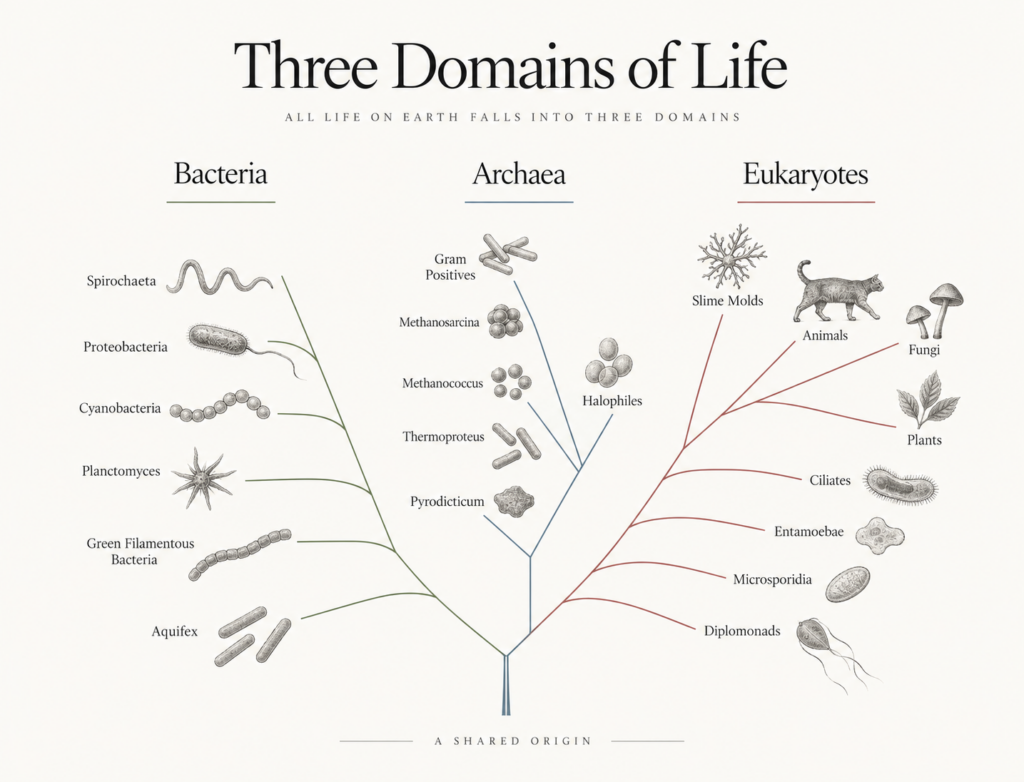
- All our diverse organisms can be categorised into three groups, called domains:
- Eukarya (eukaryotes) → all multicellular organisms (e.g. huans) and many unicellular organisms (e.g. yeast) are in this domain. Their defining characteristic is that they have a nucleus in each cell
- Bacteria → unicellular organisms (like bacteria) without a nucleus, are referred to as prokaryotes
- Archaea → prokaryotes also now include archaea, which are similar (but distinct) from bacteria