
- Biochemistry involves understanding some key concepts from chemistry e.g. chemical bonds, the structure of water, thermodynamics, etc.
Example: The DNA Double Helix
- We will use these concepts to examine an archetypical biochemical process – namely, the formation of a DNA double helix from its two component strands.
- The process is but one of many examples that could have been chosen to illustrate the topics in this note.
How the Double Helix Forms
- When scientists first observed double-stranded DNA inside a cell, two distinct possibilities existed:
- Hypothesis A (Enzyme-Dependent): Two single strands of DNA have no natural physical attraction to each other. They only stay in a double helix because cell enzymes actively push, twist, and glue them together.
- Hypothesis B (Spontaneous/Intrinsic): The physical chemistry of the DNA strands naturally causes them to attract and twist together purely through electrostatic and thermodynamic forces, without needing any enzymes.
- Observing DNA inside a cell cannot prove which hypothesis is correct because you can’t easily remove all cellular proteins from a living cell without killing it.
- To isolate the variable, scientists had to test the DNA completely outside of a biological system
- Synthetic Production: They manufactured pure DNA strands from scratch using basic chemical reagents, ensuring zero proteins, enzymes, or cell components were present.
- The Test Environment: They mixed these pure complementary single strands together in a plain solution of water and salt in a test tube.
- When they did this, the two strands automatically snapped together into a double helix in a simple test tube, it eliminated Hypothesis A.
- So why do separate strands spontaneously pull together? To explain this reaction, biochemists must analyse three things:
- Intermolecular forces: The non-covalent interactions (like hydrogen bonding and base stacking) holding the strands together.
- Thermodynamics: Whether the binding reaction releases free energy, making it energetically favourable.
- Solution conditions: How external factors – specifically pH (acid-base chemistry) and salt concentrations – affect the ability of the strands to bind.
Covalent and Non-Covalent Bonds
- Atoms link together using two distinct types of chemical bonds:
Covalent Bonds
- These are the strongest bonds e.g. they’re the bonds that hold together the atoms inside the nitrogenous bases inside DNA.
- A covalent bond is formed by the sharing of a pair of electrons between adjacent atoms.
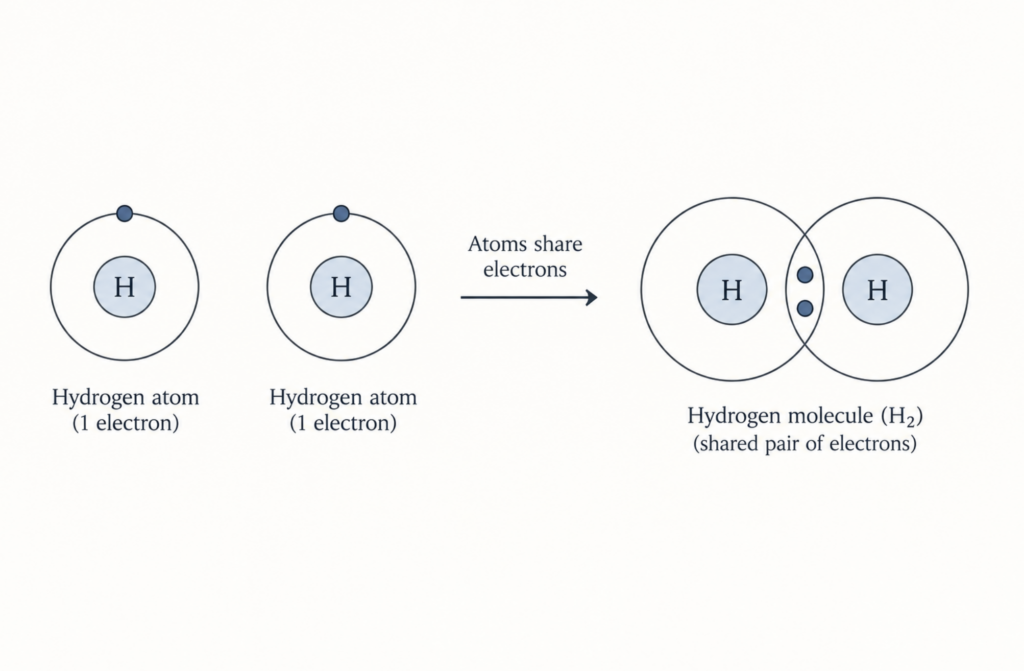
.
- Because covalent bonds are so strong you need to a lot of energy to break them apart.
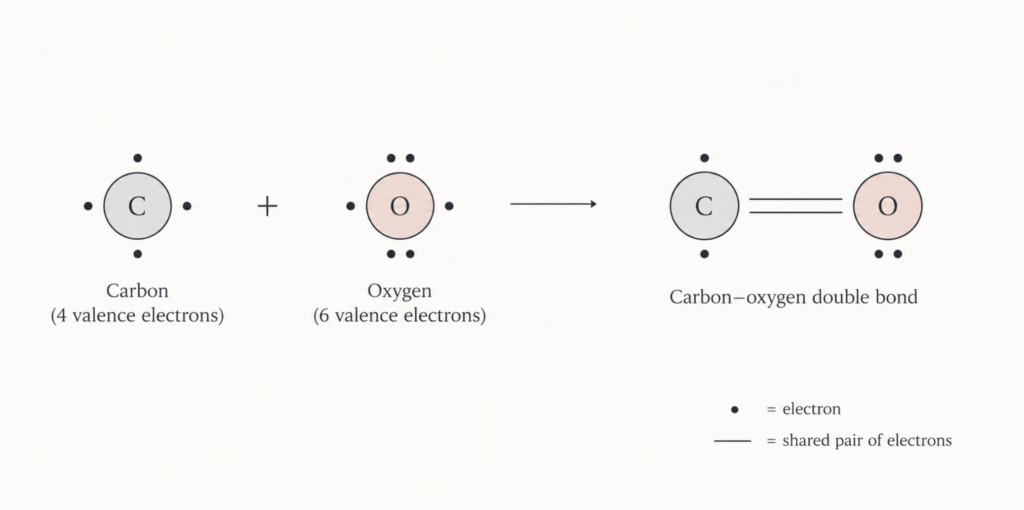
- Also, more than one electron pair can be shared between two atoms to form a multiple covalent bond, which are even stronger e.g. carbon-oxygen double bonds (C=O) found in three of the nitrogenous bases in DNA.
Distance & Energy Units
- The distance between atoms and their bond lengths are usually measured in angstrom (Å) units:
1Å = 10−10m = 10−8cm = 0.1nm- Several energy units are used:
- One joule (J) is the amount of energy required to move 1 meter against a force of 1 newton. A kilojoule (kJ) is 1000 joules.
- One calorie is the amount of energy required to increase the temperature of 1 gram of water 1 degree Celsius. A kilocalorie (kcal) is 1000 calories.
- One joule = 0.239 calories.
- For certain molecules, there isn’t just one single “correct” way to draw the covalent bonds on paper.
- Standard chemical drawings force you to put single lines (C-C) and double lines (C=C) in fixed spots. But in some molecules, the electrons are spread out rather than locked between two specific atoms.
- Because of this, you can take the exact same frame of atoms and draw the single and double bond lines in different positions, giving you two or more valid ways to draw the exact same molecule.
- As a result, chemists draw two different pictures (called resonance structures) to show the possible positions of the double bonds.
- This happens, for example, in adenine (one of our four bases in DNA):
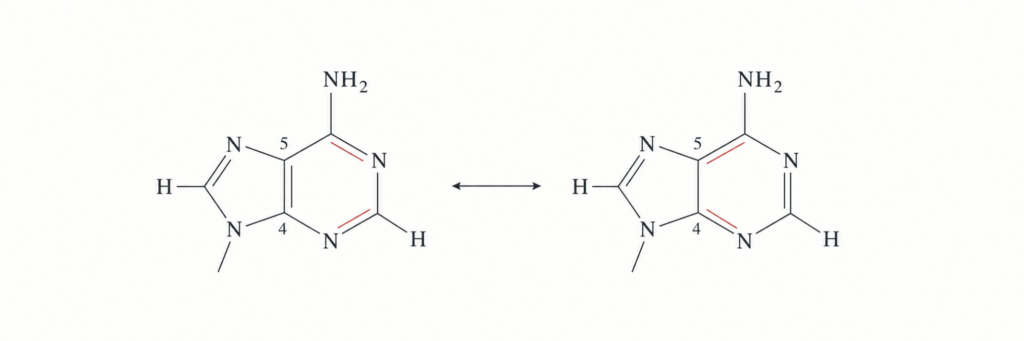
- Here we can see how the single and double bonds (the lines) switch positions between the left ring and the right ring.
- The double-headed arrow (⟷) doesn’t mean the molecule is flipping back and forth between the two shapes. It means the real molecule is a permanent composite (a 50/50 blend or average) of both drawings simultaneously.
- To prove that adenine exists as a blended composite rather than strict single or double bonds, scientists measure the physical distance between its atoms using X-ray crystallography.
| Bond type | What it represents | Standard length (A˚) |
|---|---|---|
| Pure C–C Single Bond | 1 shared electron pair | 1.54 Å |
| Pure C=C Double Bond | 2 shared electron pairs | 1.34 Å |
| Adenine C-4 to C-5 Bond | Measured inside real adenine | 1.40 Å |
- Because 1.40 Å is almost exactly halfway between a single bond (1.54 Å) and a double bond (1.34 Å), it proves the C-4 to C-5 bond behaves as a “1.5 bond” – half single bond, half double bond.
- This resonance provides extra stability:
- In physics and chemistry, whenever charge or energy is spread out over a larger area rather than concentrated in one tight spot, the overall energy state of the system drops.
- Lower energy equals greater thermodynamic stability. Because adenine can distribute its electrons across multiple resonance forms, it’s significantly more stable and resistant to chemical breakdown than a molecule with rigid, fixed double bonds.
Non-Covalent Bonds
- Non-covalent bonds are weaker, but still crucial for biochemical processes.
- There are four fundamental non-covalent bond types:
- Ionic interactions
- Hydrogen bonds
- Van der Waals interactions
- Hydrophobic interactions
Ionic Interactions
- An ionic interaction (or ionic bond) is an attraction between two atoms or molecules that carry full, opposite electrical charges.
- Unlike covalent bonds (where atoms share electrons), ionic interactions involve a complete transfer of electrons:
- One atom completely gives away an electron, while another atom takes it.
- The atom that loses a negatively charged electron becomes positively charged (+). The atom that gains the electron becomes negatively charged (-).
- Basic physics applies: opposite charges attract. The positive atom and negative atom pull directly toward each other.
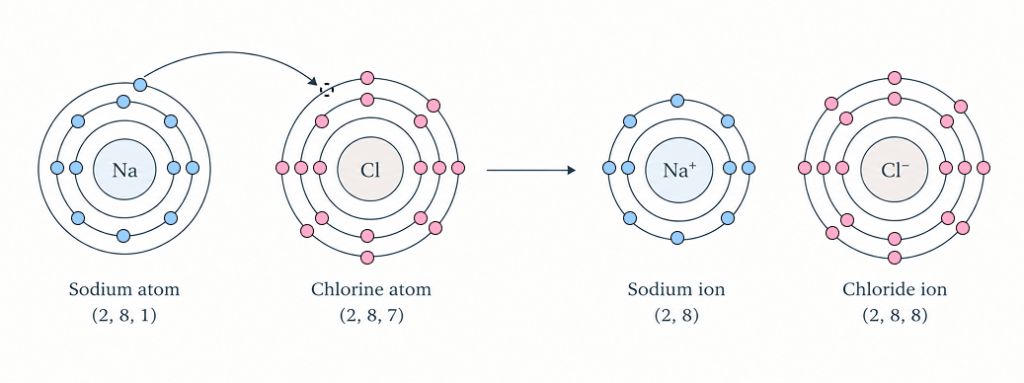
- Unlike covalent bonds, which hold atoms at very specific angles, an ionic charge pulls in every direction at once (360 degrees).
- The energy of an ionic interaction (sometimes called an electrostatic interaction) is given by the Coulomb’s energy:
Equation Explanation
- q1 and q2: This is the strength of the electrical charges on the two atoms. Bigger charges mean a stronger pull.
- r: This is how far apart the two atoms are. Because distance is on the bottom of the fraction, moving the atoms closer together makes the bond stronger, and pulling them apart makes it weaker.
- D: This measures how much the surrounding environment impacts the electrical pull.
- In water (D≈80): Water molecules crowd around the charged atoms and block their pull, making the bond weak. This is why table salt dissolves effortlessly in water.
- Inside a folded protein (D≈2): The inside of a protein is oily and keeps water out. Without water to block the charges, the ionic bond becomes extremely strong, acting like a structural rivet that holds the protein in shape.
- k: This is just a fixed number that converts the calculation into standard energy units (kJ/mol).
- By convention, an attractive interaction has a negative energy.
Hydrogen Bonds
- So far we know about covalent bonds and ionic bonds:
- A covalent bond is when two atoms share electrons.
- An ionic bond is when one atom gives an electron away, so you end up with a positive atom and a negative atom that attract each other.
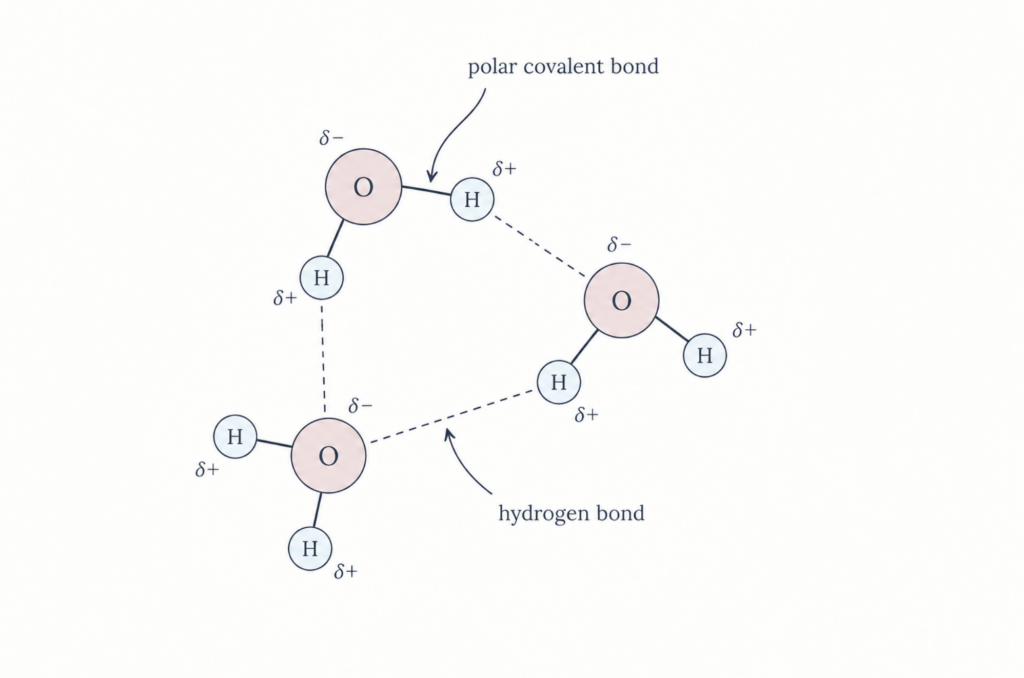
- With hydrogen bonds no electrons are shared or transferred. It’s just a small attraction between a slightly positive hydrogen on one molecule and a slightly negative atom on another molecule.
- For example, in a water molecule, each hydrogen is joined to oxygen by a covalent bond, which means they share electrons. But they do not share them perfectly evenly.
- Oxygen pulls the shared electrons closer to itself than hydrogen does. So oxygen becomes slightly negative, and hydrogen becomes slightly positive.
- That uneven sharing is what makes hydrogen bonding possible between different water molecules.
- Another example is in DNA, where hydrogen bonds act like precise chemical snaps that hold the two strands of the double helix together (specifically pairing Adenine with Thymine, and Cytosine with Guanine).
- Every hydrogen bond requires 2 specific pats:
- The donor, which is the group containing the electronegative atom (Oxygen, as in the image above, or Nitrogen) that is covalently attached to the hydrogen (written as O-H or N-H).
- The acceptor, which is the nearby electronegative atom (Oxygen or Nitrogen) that attracts the Hydrogen
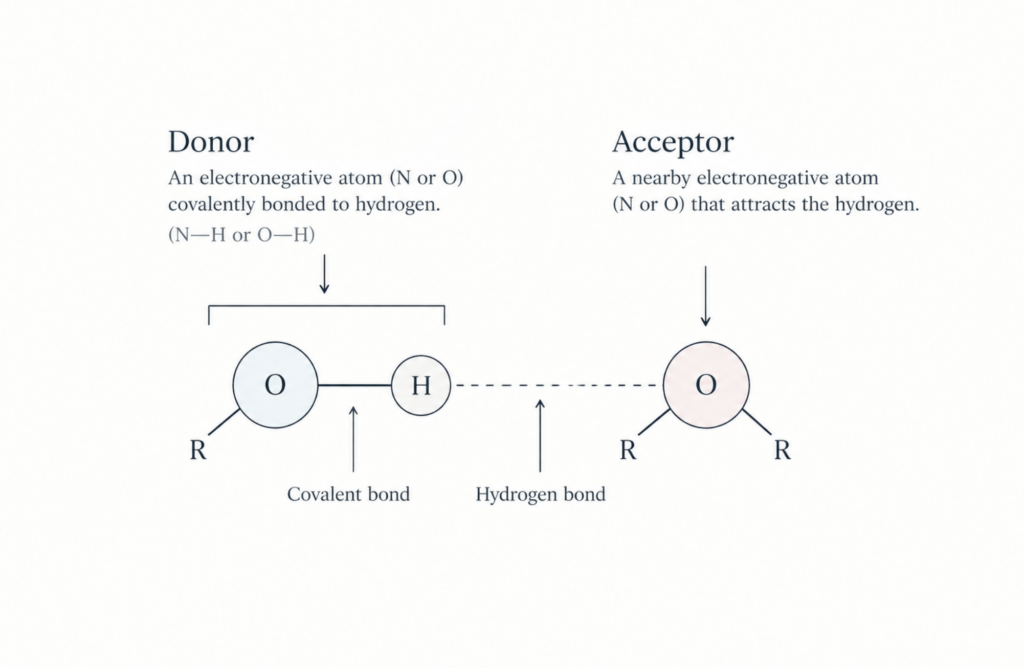
- Hydrogen bonds are much weaker than covalent bonds and their bond lengths are longer too.
- The strongest hydrogen bonds tend to be straight, such that the hydrogen-bond donor, the hydrogen atom, and the hydrogen-bond acceptor lie along a straight line.
Van der Waals Interactions
- The basis of a van der Waals interaction is that the distribution of electronic charge around an atom fluctuates with time.
- Electrons are in continuous motion around a nucleus. At any given instant, the electron cloud can become briefly asymmetrical, creating a temporary partial negative charge (δ−) on one side and a partial positive charge (δ+) on the other.
- This temporary charge distorts the electron cloud of an adjacent atom, inducing a complementary dipole in that neighbor.
- The temporary opposing partial charges briefly attract each other.
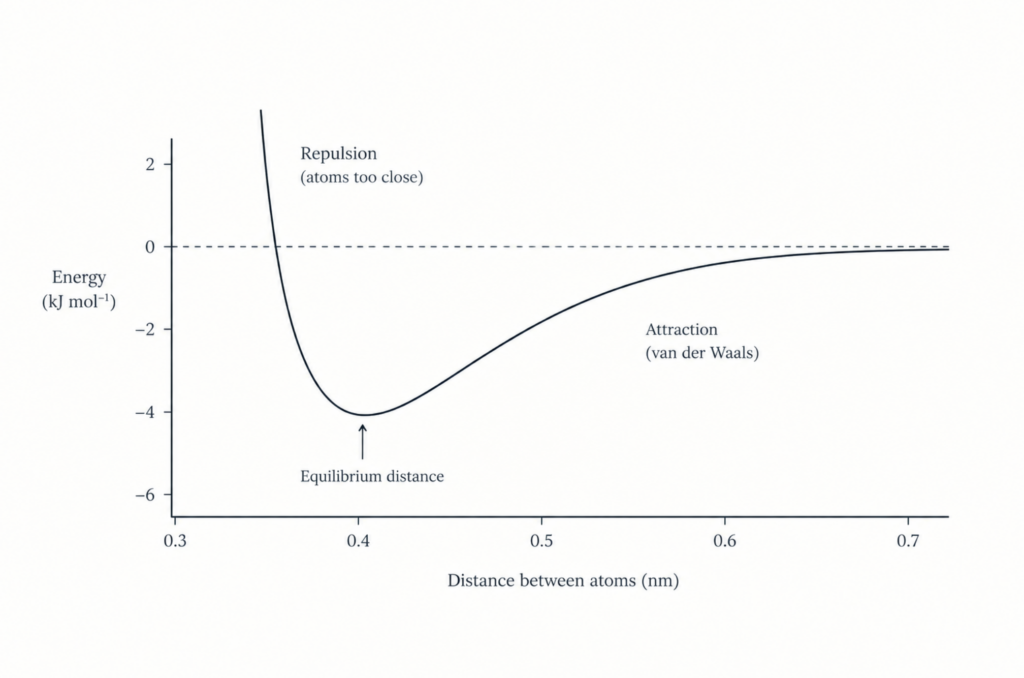
- Van der Waals interactions are highly sensitive to atomic spacing:
- Too far apart: the fields do not interact.
- Van der Waals contact distance: The optimal distance where attraction is maximal (∼2 to 4 kJ/mol).
- Too close: Electron clouds overlap, generating strong steric repulsion that rapidly pushes the atoms apart.
Hydrophobic Interactions
Properties of Water
- Most biochemical reactions take place in water.
- These properties of water are particularly relevant:
- A water molecule is asymmetrically charged. Oxygen draws electron density away from the two hydrogens, creating a partial negative charge (δ−) on Oxygen and partial positive charges (δ+) on Hydrogen.
- Water is highly cohesive, so water molecules interact strongly with one another through hydrogen bonds. These interactions are apparent in the structure of ice, which consists of a continuous, rigid hydrogen-bonded lattice. When ice melts into liquid water, roughly 25% (1 in 4) of these hydrogen bonds break, giving liquid water its fluid structure.
- Water has a high dielectric constant (D=80)1. Because water is polar, its partial charges orient themselves around dissolved ions (for example, the partial negative oxygens (δ−) turn to face positive ions (like Na+) and the partial positive hydrogens (δ+) turn to face negative ions (like Cl−). This creates a physical coating of oriented water molecules around every ion, known as a hydration shell.
- The hydration shells act as physical and electrical cushions. Instead of Na+ and Cl− pulling each other together into a solid crystal lattice, water shields their charges so completely that they remain separated and stably dissolved in solution.
- The hydrophobic effect is a manifestation of the properties of water.
- Nonpolar molecules (like hydrocarbons or lipid tails) cannot form hydrogen bonds or ionic interactions, so they offer water nothing to bind to.
- To maintain its hydrogen-bonded network despite the nonpolar intruder, water is forced to organise itself around the nonpolar molecule by forming a highly structured, rigid “cage” (a clathrate) around the nonpolar surface.
- If two separate nonpolar molecules float near each other, merging them into one cluster reduces their total combined surface area:
- Two separate molecule require two individual water cages (i.e. lots of trapped water).
- One merged cluster requires only one single water cage, which covers less total surface area.
- When the nonpolar molecules clump together and reduce their surface area, many of the water molecules previously trapped in rigid cages are therefore set free.
- These liberated water molecules return to the chaotic bulk liquid, regaining their full freedom to tumble and swap hydrogen bonds.
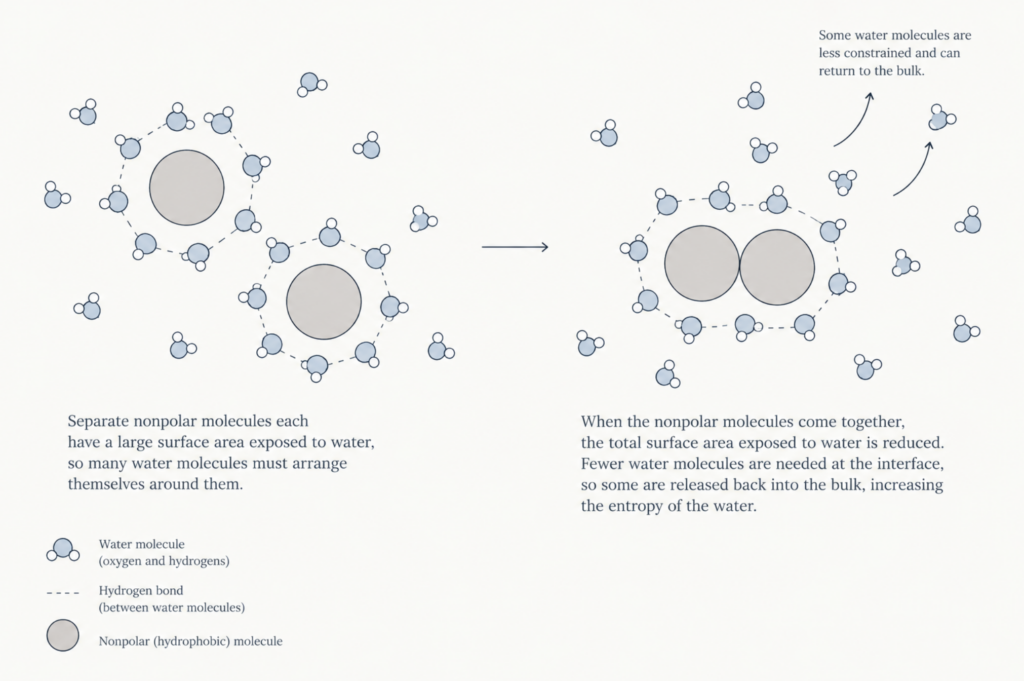
- Simply speaking, then, the hydrophobic effect is water pushing non-polar molecules together to free itself.
DNA and Non-Covalent Bonds
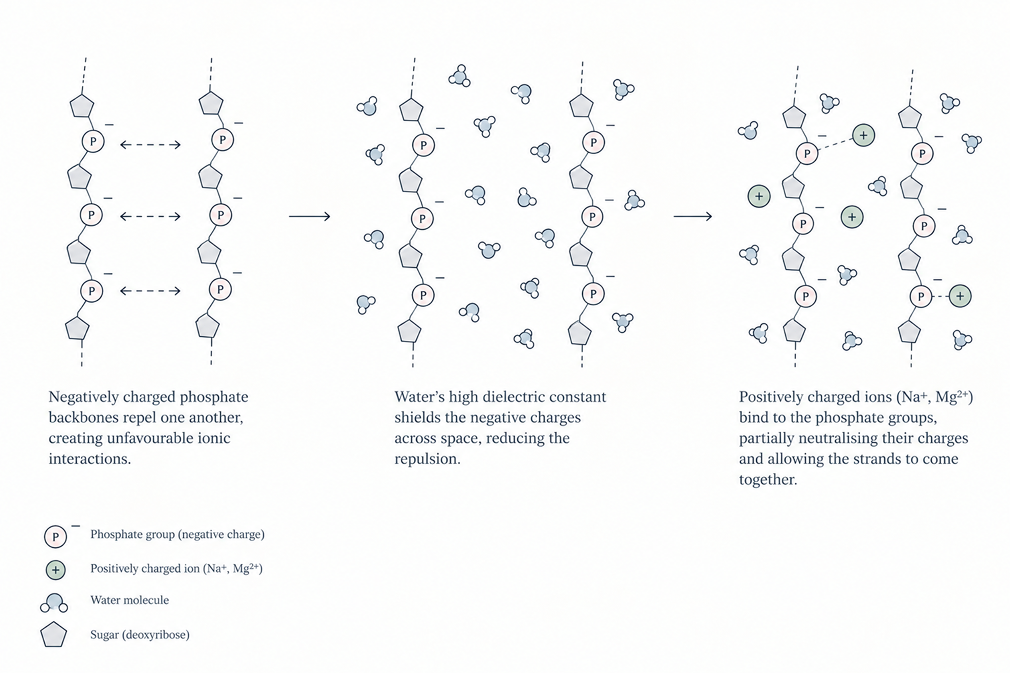
- First, the negatively charged phosphate backbones of opposing DNA strands repel one another, creating unfavourable ionic interactions that actually oppose double helix formation. This repulsion is weakened by two factors (See Fig 01):
- Water’s high dielectric constant: this shields the negative charges across space.
- Positively charged ions (Na+, Mg2+): these bind directly to the phosphate groups, partially neutralising their charges and allowing the strands to come together.
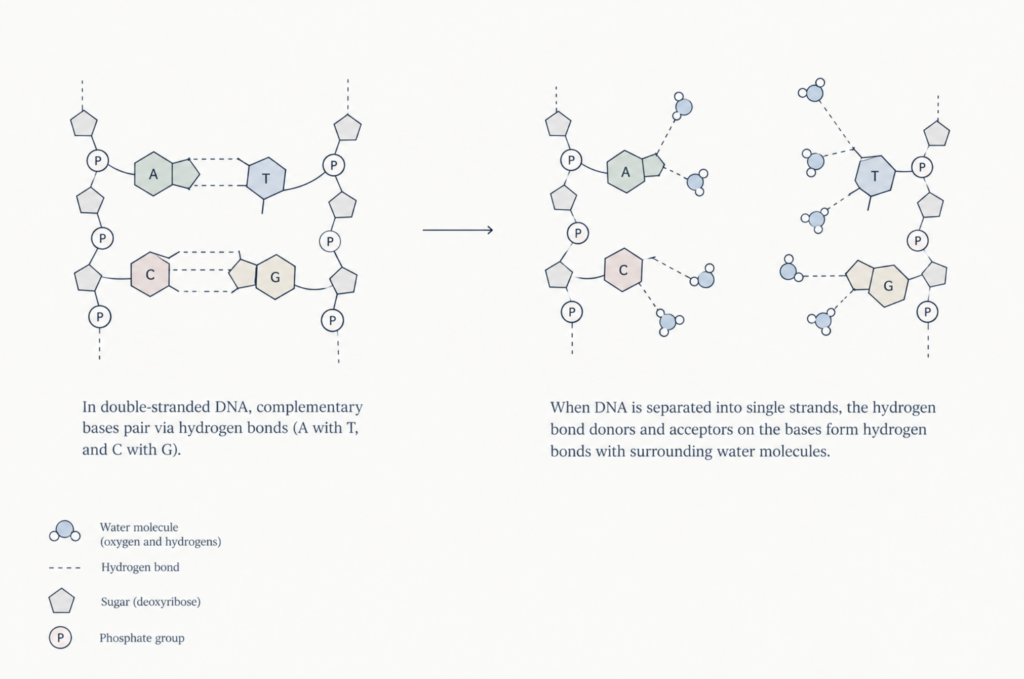
- Second, in double-stranded DNA, hydrogen bonds are important to pair specific bases together (A with T, and C with G). But, when DNA is separated into single strands, those matching sites (donors and acceptors) aren’t left hanging. Instead, they form hydrogen bonds with surrounding water molecule (See Figure 02).
- To form a double helix, single strands must break their hydrogen bonds with water to make new hydrogen bonds with each other.
- Hydrogen bonds act like a strict quality-control check. If two bases don’t match (like trying to pair Adenine with Cytosine) water molecules are still stripped away (breaking H-bonds), but the bases fail to form new H-bonds with each other.
- Third, inside the double helix, flat base pairs sit parallel to one another, stacked vertically like a neat pile of coins. The space between adjacent base pairs (about 3.4 to 3.6 Å) happens to be the exact distance where Van der Waals interactions reach their maximum strength.
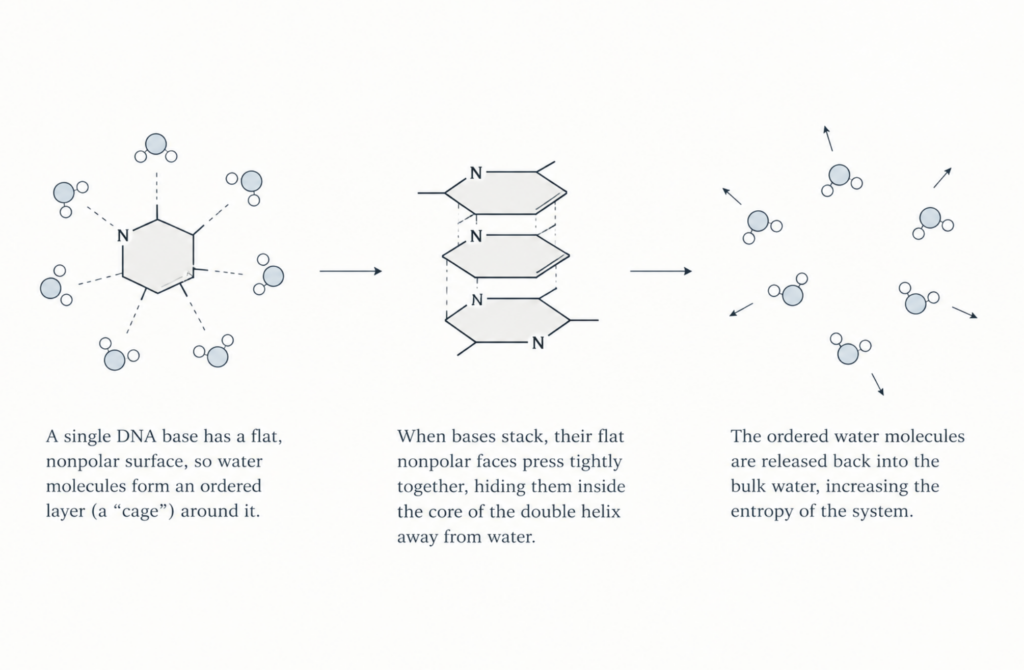
- Fourth, the flat ring structures of the DNA bases are nonpolar. When base pairs stack vertically like a pile of coins, their flat nonpolar faces press tightly against each other, hiding them inside the core of the double helix away from water. Hiding those nonpolar surfaces means water no longer has to form rigid “cages” around them. Trapped water molecules are released back into the liquid, gaining entropy (Fig 03).
The Laws of Thermodynamics
- The laws of thermodynamics distinguish between a system and its surroundings.
- A system refers to the matter within a defined region of space. The matter in the rest of the universe is called the surroundings.
The First Law of Thermodynamics
Energy cannot be created or destroyed, but can only be transformed from one form to another or transferred between a system and its surroundings
- In other words, the energy content of the universe is constant.
- Energy can take different forms, though e.g. kinetic energy turns into heat energy.
- Energy can also be present as potential energy – energy that will be released when some prices happens e.g. a ball held up high has potential energy, because when released it gets kinetic energy.
- Within chemical systems, potential energy is related to the likelihood that atoms can react with one another e.g. a mix of gasoline and oxygen has a large potential energy because these molecules may react to form carbon dioxide and water and release energy as heat.
- The First Law also dictates that when atoms snap together to form a chemical bond, energy is released into the system too, so must take on a new job/form:
- It can be used to break other bonds.
- It can escape into the surroundings as heat (warming the solution) or light (like a flame)
- It can be converted into kinetic energy (movement) or potential energy in another molecule.
The Second Law of Thermodynamics
The total entropy of an isolated system must always increase or remain constant over time, meaning natural processes are irreversible and energy spreads out rather than concentrating.
- In other words, the amount of disorder in a system increases over time.
- For example, the release of water from non-polar surfaces responsible for the hydrophobic effect is favourable because water molecules free in solution are more disordered than when they were associated with the nonpolar surfaces.
- The Second Law does seem to contradict our experiences (e.g. a leaf forming from carbon dioxide and other nutrients). But, entropy may be decreased locally to form ordered structures only if entropy in other pars of the system is increased by an equal or greater amount.
- The local decrease in entropy is often accomplished by releasing heat, which increases the entropy of the surroundings.
Gibbs Free Energy
- The entropy (S) of the system may change in the course of a chemical reaction by an amount
- If heat flows from the system to its surroundings, then the heat content (enthalpy, H) of the system reduces by an amount and the entropy of the surroundings () increases
- The precise change in the entropy of the surroundings depends on the temperature (T). The change in entropy is greater when heat is added to relatively cold surroundings.
- So, when a reaction in a test tube releases heat (), that heat warms up the surrounding environment, making the surrounding molecules move faster and become more disordered ():
- The total change in universe entropy () is the sum of disorder inside the test tube plus disorder in the surroundings:
- Substituting equation 1 into equation 2 gives us:
- Multiplying the entire equation by -T puts it into units of energy (Joules) and defines the new term, ΔG
- The function −TΔS is referred to as free energy or Gibbs free energy.
- ΔG is essentially. an accounting shortcut. It combines the heat released/absorbed () and internal disorder () into a single number i.e. it keeps track of both the entropy of the system (directly) and the entropy of the surroundings (in the form of heat released from the system).
- So what does the sign of ΔG actually tell us?
- The Second Law says a reaction only happens naturally if total chaos increases ().
- Because the formula puts a minus sign in front of entropy (ΔG= ), more chaos = a negative number for ΔG.
- Therefore:
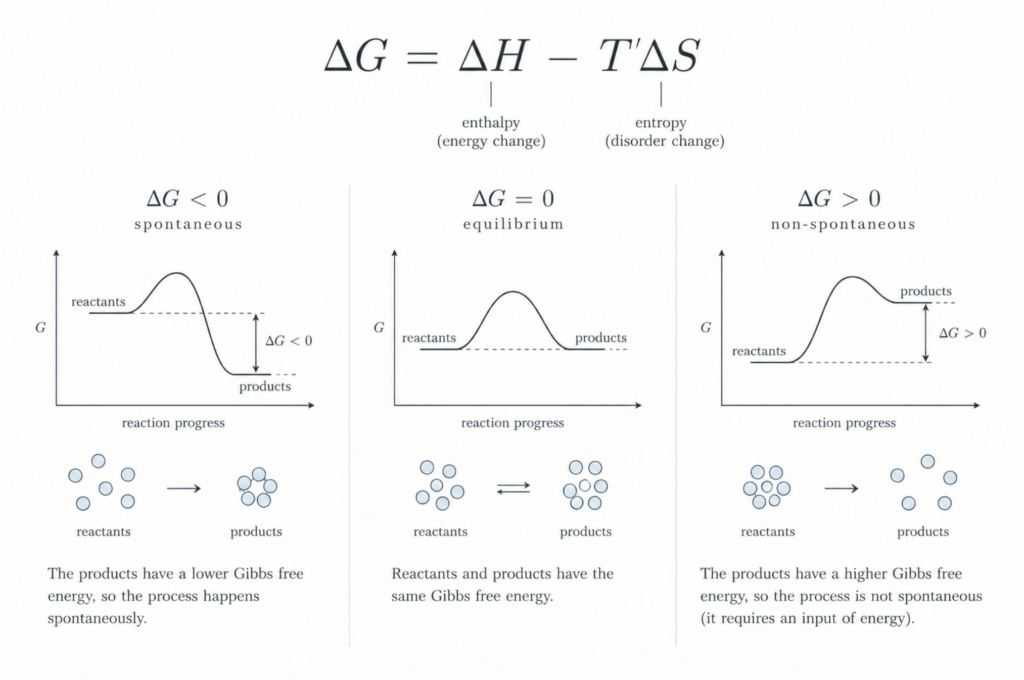
- If ΔG<0 (Negative): Spontaneous. The reaction happens on its own because total universe disorder increased.
- If ΔG>0 (Positive): Non-spontaneous. The reaction will not happen unless external energy is added.
- If ΔG=0: Equilibrium. The reaction is balanced. Nothing overall is changing.
DNA and Thermodynamics
- Tbc.
- The dielectric constant (D) is simply a measure of how good a material is at shielding charges. The higher the number the better the shield. For example water (D = 80) is an excellent shield, reducing the electrical force between charges to 1/80th of its normal strength. ↩︎